Use AI with sensitive information while retaining control over model access and permitted actions. Ardua AI applies your organization's rules to governed AI requests, supports local and approved cloud models, and records the decisions behind each execution.
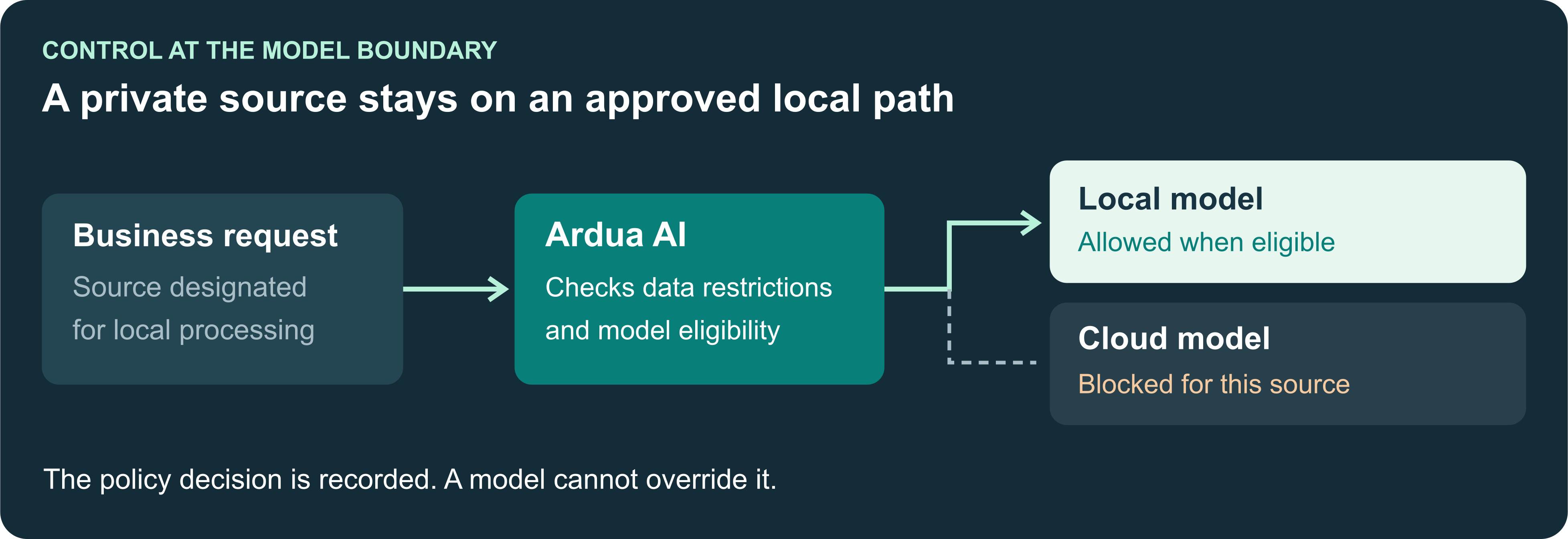
Illustrative routing decision for a source designated for local processing.
01
Keep sensitive data where it belongs
On governed execution paths, restrictions are checked before information reaches a model. Those restrictions carry forward when new data enters an analysis, so earlier cloud permission cannot override later data-handling requirements.
02
Choose models without surrendering control
Use local models for private processing and approved cloud models for eligible work. Ardua AI separates application behavior from model access. If no suitable model is permitted, the request is refused rather than sent somewhere unauthorized.
03
Limit what AI can do
For tools and data access executed through the platform, Ardua AI checks permission before acting on a model's proposal. A model cannot give itself additional authority. Your team defines the task and its permitted boundaries.
04
Explain decisions after the fact
Records identify the rules applied, provider used, and reasons for allowing or blocking an action. Investigate data handling without routinely duplicating sensitive source data in the governance log.
Public-sector and data-sovereign deployment
A practical foundation for data-sovereign AI.
For governments and institutions with strict data-residency requirements or constrained recurring budgets, Ardua AI supports an operating model built around locally controlled infrastructure.